Virginia has quietly become one of the more durable CNC manufacturing markets on the East Coast. Aerospace, defense, energy, and advanced industrial manufacturing continue to anchor demand, while smaller precision shops support everything from medical devices to custom automation. For CNC professionals, this creates a labor market that rewards both specialization and stability.
This guide covers the top CNC companies in Virginia, how they differ by region and sector, and what job seekers and shop owners should understand.
Table of Contents
Why Virginia Remains a CNC Manufacturing Stronghold
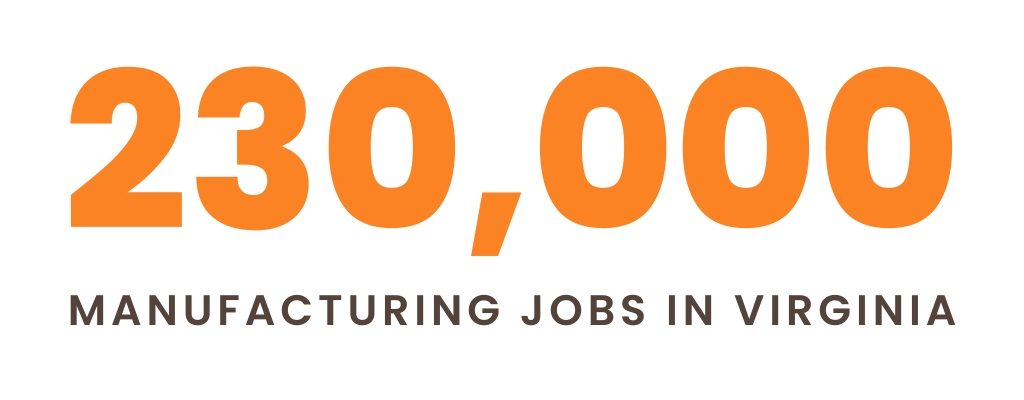
Manufacturing remains a stable part of Virginia’s economy even as broader labor markets fluctuate. Employment data from the Federal Reserve Bank of St. Louis, based on Bureau of Labor Statistics figures, show that manufacturing employment in Virginia has consistently accounted for around 230,000 jobs through 2025, tracking all employees in manufacturing sectors within the state. This consistency points to an ongoing base of production activity that supports CNC and precision machining roles.
Demand is not driven by one industry cycle. Defense contracts, nuclear components, aerospace systems, and infrastructure projects all rely on precision machining, often with long production timelines.
That mix matters. It reduces hiring whiplash and supports shops willing to invest in multi axis capability, automation, and experienced operators.
What Defines a Top CNC Company in Virginia
Size alone is not the differentiator. The strongest CNC employers in Virginia share a few consistent traits.
They run modern equipment. Five axis mills, horizontal machining centers, live tooling lathes, and integrated automation are common.
They work in regulated or mission critical environments. Defense, aerospace, nuclear, and energy clients impose quality standards that reward disciplined shops.
They invest in workforce continuity. Apprenticeships, internal training, and promotion from within appear more often than short term labor cycling.
For job seekers, these factors usually translate into better pay stability, predictable schedules, and clearer advancement paths.
Top CNC Companies in Virginia by Industry
Defense and Shipbuilding Manufacturers
Southeastern Virginia is dominated by defense manufacturing tied to naval operations.
Huntington Ingalls Industries in Newport News operates one of the largest concentrations of CNC machining in the state, supporting aircraft carriers and submarines. Machinists here work on large scale components with tight tolerances and long production horizons.
The work is complex and highly regulated. Turnover tends to be lower than average, but hiring standards are strict, including security requirements.
Aerospace and Turbine Manufacturing
Central Virginia hosts several aerospace and energy-focused manufacturers with heavy CNC demand.
Rolls Royce North America maintains advanced manufacturing operations in Prince George County, producing components for aircraft engines and power systems. CNC machinists in these facilities often specialize in exotic alloys and multi axis machining.
BWX Technologies in Lynchburg supports nuclear and defense programs, relying on precision machining under stringent quality systems. CNC roles here skew toward experienced machinists comfortable with documentation and inspection driven workflows.
Precision Job Shops and Contract Manufacturers
Northern and western Virginia support a dense network of small to mid-sized CNC job shops. These companies rarely make headlines but account for a significant share of hiring.
Shops in this category typically serve medical, automation, and industrial OEM clients. Work is faster paced. Setup skill matters as much as cycle time.
A consistent pattern emerges. Machinists with strong programming and troubleshooting skills move quickly into lead roles because these shops cannot afford downtime.
Regional CNC Hiring Patterns Across Virginia
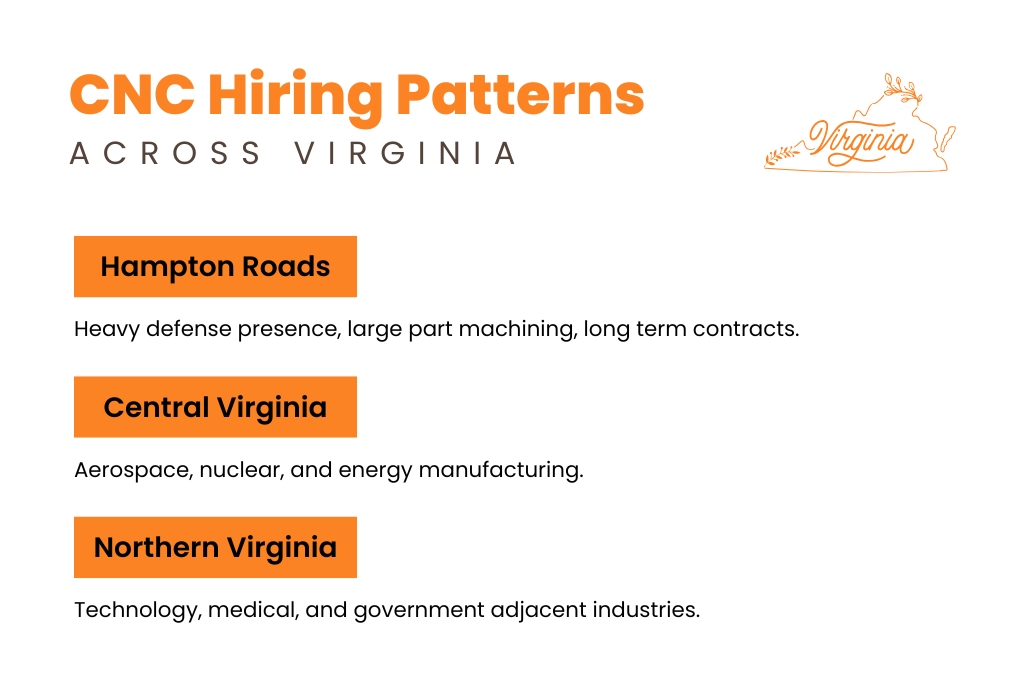
Hampton Roads
Heavy defense presence. Large part machining. Long term contracts. Security clearance requirements are common.
Central Virginia
Aerospace, nuclear, and energy manufacturing dominate. Tighter tolerances, more documentation, and slower but steadier production schedules.
Northern Virginia
Smaller CNC shops clustered around technology, medical, and government adjacent industries. Faster turnaround work and higher demand for programming versatility.
Understanding these regional differences helps job seekers avoid mismatches between expectations and reality.
How CNC Hiring is Changing in Virginia
Virginia CNC employers are not just competing with each other. They are competing with automation.
Shops are increasingly selective, favoring machinists who can do more than load parts. Setup reduction, tool optimization, probing, and basic automation troubleshooting are now baseline expectations in many facilities.
At the same time, retirements continue to thin senior machinist ranks. BLS CPS age data shows about 26% of U.S. manufacturing workers are age 55 or older, reinforcing the near-term pressure on experienced machining and setup talent.
This retirement trend often leads to accelerated advancement for mid-career machinists who can mentor junior staff while maintaining output.
What CNC Job Seekers Should Evaluate Beyond Pay
Compensation matters, but it rarely tells the full story.
Look at machine mix. Shops running modern equipment tend to invest more consistently in people.
Ask about inspection responsibility. Companies that integrate machinists into quality processes usually offer higher skill ceilings.
Pay attention to schedule predictability. Defense and aerospace environments often mean steadier hours than high mix job shops.
A machinist moving from a short run shop into a regulated environment may see slower pace but longer career stability.
What CNC Shop Owners Can Learn from Market Leaders
The most resilient CNC companies in Virginia are not chasing volume at all costs.
They focus on fewer clients, deeper integration, and repeatable quality. That approach supports better margins and makes workforce planning easier.
Owners who invest in training pipelines, even modest ones, reduce dependence on a shrinking external talent pool. This becomes a competitive advantage as experienced machinists grow more selective.
Conclusion
Virginia’s CNC manufacturing market rewards specialization, patience, and technical depth. The top CNC companies in the state are not defined by size alone, but by the complexity of their work and their commitment to skilled labor.
For job seekers, understanding regional and industry differences is the fastest way to find a role that lasts. For employers, the message is just as clear. Shops that invest in capability and people will continue to win the talent battle.