
Ask three rural CNC shop owners why they can’t fill a setup position and you’ll hear three answers.
“Kids don’t want to work.”
“Pay isn’t competitive anymore.”
“Everyone’s going to the city.”
Only one of those is close to the mark, and even that one is incomplete.
The real issue is geography. Most rural counties simply do not contain many mid-career machinists. When one leaves, there is often no obvious replacement that’s within a reasonable commute.
You’re not competing in the same labor market as a shop outside a metro corridor. You’re competing in a much thinner one.
Table of Contents
The Candidate Pool Is Smaller Than You Think
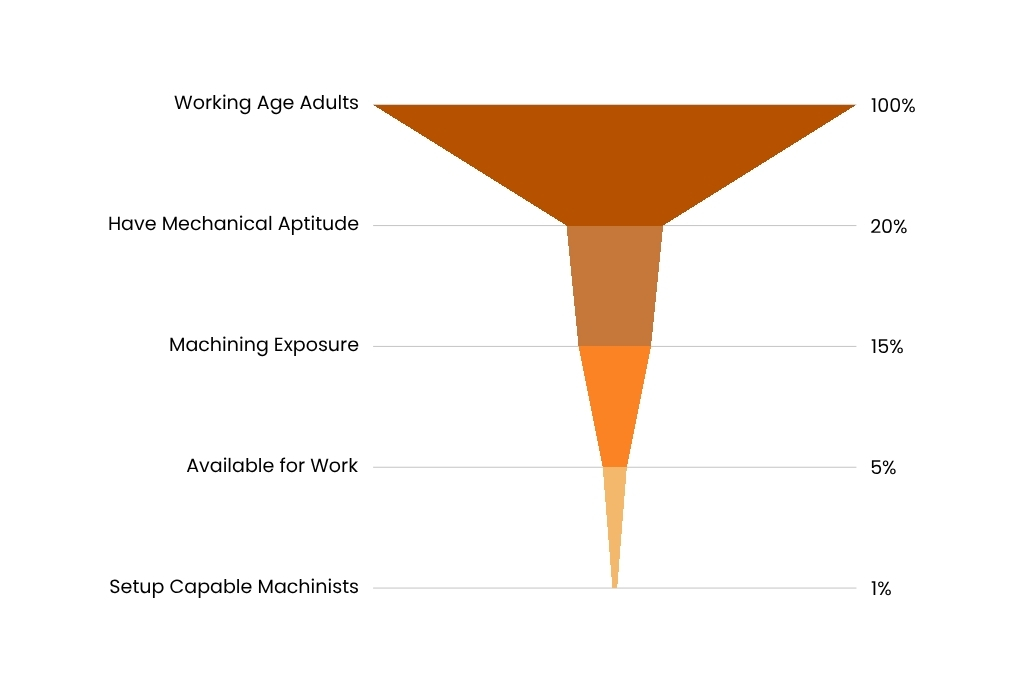
Look at your county. How many people live there? Now ask a more specific question.
How many:
- Are between 25 and 54
- Have mechanical aptitude
- Have at least some machining exposure
- Are not already employed somewhere stable
The number drops fast as you ask each question.
Rural counties skew older. Younger adults leave for school or larger employers. When that happens for a decade or two, you don’t just lose population; you lose the middle layer of your workforce.
That middle layer is exactly who rural CNC shops need most. Not entry-level labor. Not engineers. Setup-capable machinists who can hold tolerance without supervision.
When the labor pool is thin to begin with, every departure matters more.
A National Shortage Makes a Thin Market Thinner
Manufacturing has been talking about labor shortages for years. The projected gap of over two million jobs by 2030 gets quoted often. What matters more is how shortages show themselves in reality.
When labor is tight nationally:
- Larger manufacturers recruit beyond their home county.
- Signing bonuses become normal.
- Clear career ladders attract mid-level talent.
If you run a 20-person shop, you are not just competing with the shop down the road. You are competing with the regional plant that offers tuition reimbursement and defined progression.
The bigger employer doesn’t need all your people. They just need one or two of your strongest.
That’s why small shops feel national shortages first. Not because they’re worse employers, but because they operate with less redundancy.
The Pipeline Problem Is More Basic Than Most Admit
You will often hear that schools need to “push the trades.”
The more practical issue is exposure and scale.
If a student never steps inside a machine shop during high school, machining rarely becomes a default career choice. Interest usually follows familiarity.
In many rural districts, hands-on programs exist but are broad. Welding, construction, small engine repair. CNC concepts may get a unit or two but not immersion.
Community colleges do better, but they serve wide areas. A 50-mile commute kills consistency. A class that starts with 18 students may only graduate 8. Then half of those graduates move to a location where larger employers cluster.
The result is predictable. Your local pipeline produces a trickle, not a stream.
Retirements Hit Rural Shops Like a Hammer
When a senior machinist retires in a large facility, another experienced machinist often absorbs the workload. Knowledge diffuses.
In a small rural shop, that same retirement can feel like a systems crash.
What leaves with that person?
- The fixture tweaks that never made it to paper
- The instinct for when a tool is about to fail
- The understanding of which customer tolerances actually matter and which are negotiable
- The calm under pressure when a job starts drifting
Hiring another machinist does not replace that immediately. You’re trying to replace years of accumulated pattern recognition in a labor market that may not contain many people at that level.
That’s why rural CNC shops’ struggles often intensify after one retirement. The replacement market is shallow.
Pay Helps, But It Cannot Invent Skilled People
Raising wages can absolutely improve applicant quality. It can also justify a longer commute.
What it can’t do is create experienced setup talent in a county where very few exist.
In some rural regions, higher pay expands your recruiting radius. In others, the surrounding counties look similar. Same age profile. Same outmigration. Same thinning mid-career layer.
Pay is a selling point. It is not a solution on its own.
Owners who expect compensation alone to fix hiring often end up frustrated because they are solving the wrong constraint.
What Actually Changes Outcomes for Rural CNC Shops
The shops that stabilize hiring do a few things differently. Not dramatically, just deliberately.
They Formalize Skill Development Instead of Relying on Informal Training
Many small shops “train” by proximity. A new hire stands next to a senior machinist and absorbs what they can.
That works until the senior machinist is overloaded or retires.
A simple written progression changes the game. Define what competent looks like at each stage. Tie pay to demonstrated skills. Assign responsibility for teaching specific competencies to new hires.
This does not require an HR department. It requires clarity and intentionality.
Employees stay longer when progression is visible. They also reach productivity faster because expectations are concrete.
They Recruit Beyond the Immediate County Line
If your entire hiring strategy depends on who lives within 20 minutes, you have already limited yourself.
The better approach is regional thinking.
Look one or two counties out. Identify where machinists cluster. Then remove friction:
- Four 10-hour shifts instead of five 8-hour shifts
- Start times that allow for realistic commuting
- Modest relocation assistance that reduces upfront risk
These adjustments do not turn a rural shop into a metro employer. They make commuting rational.
They Fix Visibility So They Are Not Invisible
Many rural CNC shops are excellent workplaces and almost impossible to find online.
Machinists searching within a 75-mile radius often rely on digital tools. If your posting is buried or absent, you are not in the running.
Specialized platforms matter here. A site like Only CNC Jobs filters for CNC-specific talent instead of scattering your role among unrelated listings. That alone does not guarantee hires, but it does improve your visibility and your employer brand.
Visibility widens your net. In thin labor markets, that matters immensely.
They Engage Schools Early and Consistently
Rural CNC shops engage with schools not as charity but as supply planning.
One tour per semester. One paid summer helper slot. One advisory board seat.
Over time, students begin to associate your shop with opportunity rather than mystery. Parents begin to see a path. Counselors start mentioning your name.
You are not solving next month’s vacancy. You’re shaping your future five years out.
The Hard Truth Rural Shops Face
Rural CNC shops operate in tighter labor markets by default. Smaller working-age populations. Fewer mid-career machinists. Stronger pull from regional hubs.
That does not mean growth is impossible. It means hiring must be treated as a structural function of the business, not an occasional administrative task.
The owners who adapt stop blaming culture and start engineering their labor supply the same way they engineer their processes.
It is less dramatic than most hiring advice suggests, but it’s also more effective.
If recruiting feels harder every year, it probably is. The data supports that. The shops that acknowledge the structural reality tend to outlast the ones waiting for the labor market to “go back to normal.”
Work with the local resources you have. Expand your network out a few counties. Offer incentives to make the commute worth it. And if you’re still struggling to reach candidates, speak to the CNC hiring experts at Only CNC Jobs. We can help you market your open roles to a niche market that specializes in the CNC industry.