A CNC Setup Operator prepares automated cutting machines to make metal or plastic parts. You install the cutting tools, position the raw material, program the exact measurements into the machine’s computer, run a test piece, and fix any problems before production starts.
This job pays an average of $62,338 per year in the United States. You don’t need a four-year college degree. Most people start with a six-month to two-year community college program, then work their way up from basic machine operator to setup operator within one to three years.
Thousands of companies across the U.S. are hiring for these positions right now.
What Is a CNC Setup Operator?
What Setup Operators Do
Your job is to get the machine ready to make parts.
First, you read the blueprint to see what part needs to be made and how accurate it needs to be. A blueprint might say “drill a hole exactly 0.500 inches wide, no more than 0.502 and no less than 0.498.”
Then you:
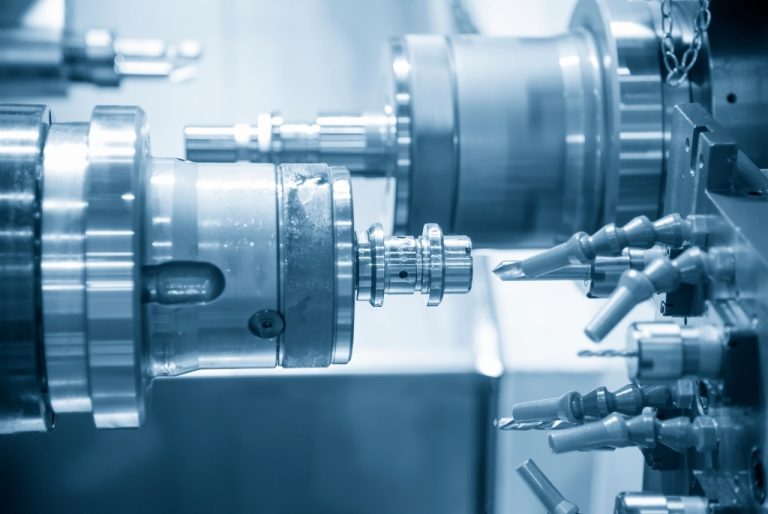
- Choose the right cutting tools (drills, mills, etc.)
- Install them in the machine
- Clamp the raw material in place
- Enter numbers into the machine’s computer telling it exactly where the material and tools are located
- Run one test part
- Measure the test part with precision tools
- Adjust the machine if measurements are wrong
- Run a few more parts to make sure everything stays accurate
CNC setup work also means watching for problems during production. If a cutting tool gets dull, dimensions will start drifting. If the part vibrates during cutting, the surface will look rough. You catch these issues and fix them.
How Setup Operators Fit into CNC Careers
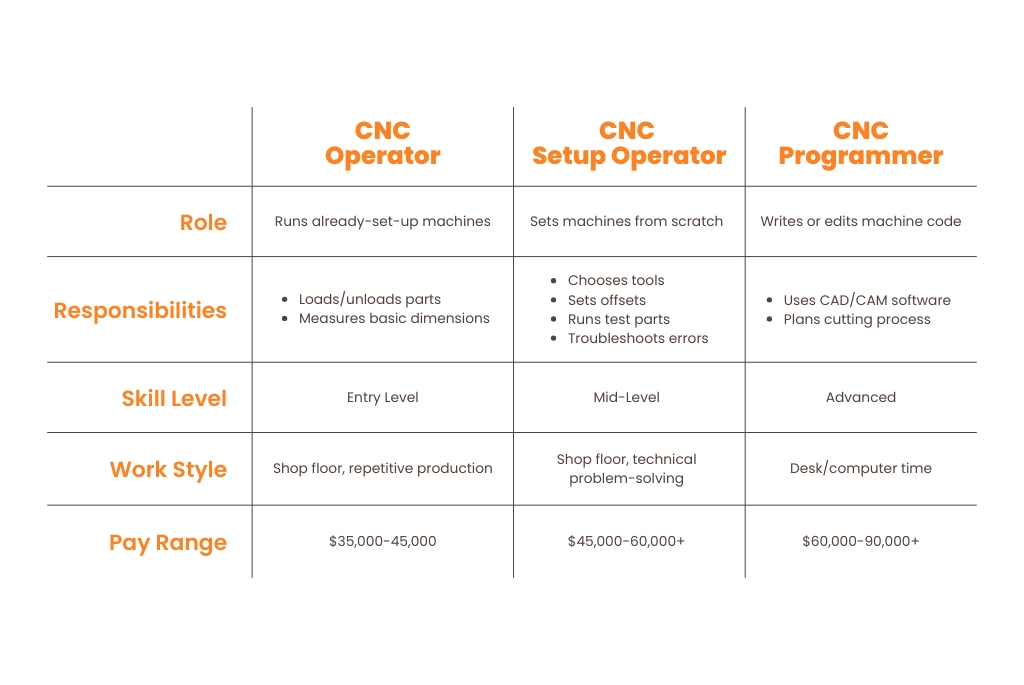
There are three main jobs on a CNC shop floor:
CNC Operator (entry level): You load material into a machine that’s already set up, press the start button, wait for the part to finish, take it out, and measure it. Starting pay: $35,000-$45,000.
CNC Setup Operator (mid-level): You do everything an operator does, plus you set up the machine from scratch. You choose tools, program measurements, run test parts, and solve problems. Starting pay: $45,000-$55,000.
CNC Programmer (advanced): You write the computer code that tells the machine how to cut. You work mostly at a desk using CAD/CAM software. Pay: $60,000-$90,000+.
Setup operator is the middle step. You’re learning how the programming works without needing to write it yourself yet. You’re doing more than pressing buttons, but you’re not designing the entire cutting process.
Why This Role Is a Strong Entry Point into CNC Careers
Skills You Build on Day One
Reading blueprints: Every part starts with a technical drawing. You’ll learn what symbols mean, how to read dimension callouts, and what tolerances apply to different features. Within six months, you’ll read blueprints as easily as a roadmap.
Precision measurement: You’ll use micrometers (measures to 0.0001 inches), calipers (measures to 0.001 inches), and height gauges. You’ll learn which tool to use when, and how to tell if a part is actually within tolerance or just close enough.
Machine troubleshooting: Setup machinists learn to recognize problems by sound and appearance. A chattering noise means the part is vibrating loose. Burn marks on the metal mean the cutting speed is too fast. Rough surface finish means the tool is dull or the feed rate is wrong.
Material knowledge: Aluminum cuts fast and easy. Steel requires slower speeds and more cutting fluid. Stainless steel dulls tools quickly. Titanium generates extreme heat. You learn these differences through daily experience.
Accessible Training Pathways
Community college CNC programs run 6 months to 2 years. You’ll spend about half your time in the shop running actual machines, half in the classroom learning blueprint reading and basic programming. Cost: $3,000-$15,000 total depending on your state.
Programs worth considering teach on machines made within the last 10 years. If the school’s equipment looks like it’s from the 1990s, find a different program. Community college training should prepare you for machines you’ll actually use at work.
Apprenticeships combine classroom learning with paid work. You start at around $15-$18 per hour and increase every six months as you learn more skills. Programs last 2-4 years. You graduate with zero debt and 8,000+ hours of actual machine experience.
On-the-job training at smaller shops occasionally happens. They’ll hire someone with no experience at $14-$16 per hour and train them over 6-12 months. This is less common than it used to be, but it still exists in areas where qualified workers are hard to find.
Certifications That Boost Credibility
NIMS (National Institute for Metalworking Skills) offers tests that prove you can actually do specific tasks. For example, the “CNC Milling Level 1” test requires you to make an actual part within tolerance while being watched. Pass the test, get a credential that any U.S. manufacturer recognizes.
Cost: $100-$200 per test.
Value: NIMS certification can increase starting pay by $2-$5 per hour because employers know you can do the work, not just talk about it.
Haas certification teaches you to operate Haas brand machines, which are extremely common in small and medium shops. Haas runs training programs at technical schools across the country. Free to students enrolled in partner schools.
Many shops use Haas machines exclusively, so this certification means you can walk in and operate their equipment on day one with no additional training.
Salary & U.S. Job Market Data (2026)
Average Salary
According to Glassdoor, CNC Setup Operators earn:
- Average: $62,338 per year
- Entry level: $40,000-$50,000 per year
- Experienced: $70,000-$87,598 per year
Breaking this down by hourly rate:
- Entry level: $19-$24 per hour
- Mid-career: $28-$33 per hour
- Experienced: $34-$42 per hour
Industry differences matter:
- Aerospace companies: $65,000-$85,000 (higher pay because parts require extreme precision)
- Medical device manufacturers: $60,000-$80,000 (clean room environments, tight tolerances)
- Automotive suppliers: $50,000-$65,000 (high volume work, less complexity)
- General job shops: $45,000-$60,000 (varied work, smaller companies)
Geography matters:
- Michigan, Ohio, Texas, North Carolina pay $5,000-$10,000 more than national average due to concentrated manufacturing
- Rural areas sometimes pay above average because qualified workers are scarce
- California and Northeast pay higher wages but cost of living offsets the difference
Job Openings & Demand
Indeed currently shows thousands of open CNC setup operator positions across the United States.
Why demand stays strong:
- Smaller production runs: Instead of making 10,000 identical parts, manufacturers now make 500 parts of 20 different designs. Each design change requires a new setup.
- Faster turnarounds: Customers want parts in days, not weeks. This means more frequent machine reconfiguration.
- Retiring workforce: Many experienced machinists are 55+ years old and leaving the workforce.
Automation hasn’t eliminated setup jobs. Machines can change their own tools automatically, but someone still needs to load the correct tools, position the workpiece, verify the first part is correct, and monitor production.
Early-Career Pay vs. Skill Growth
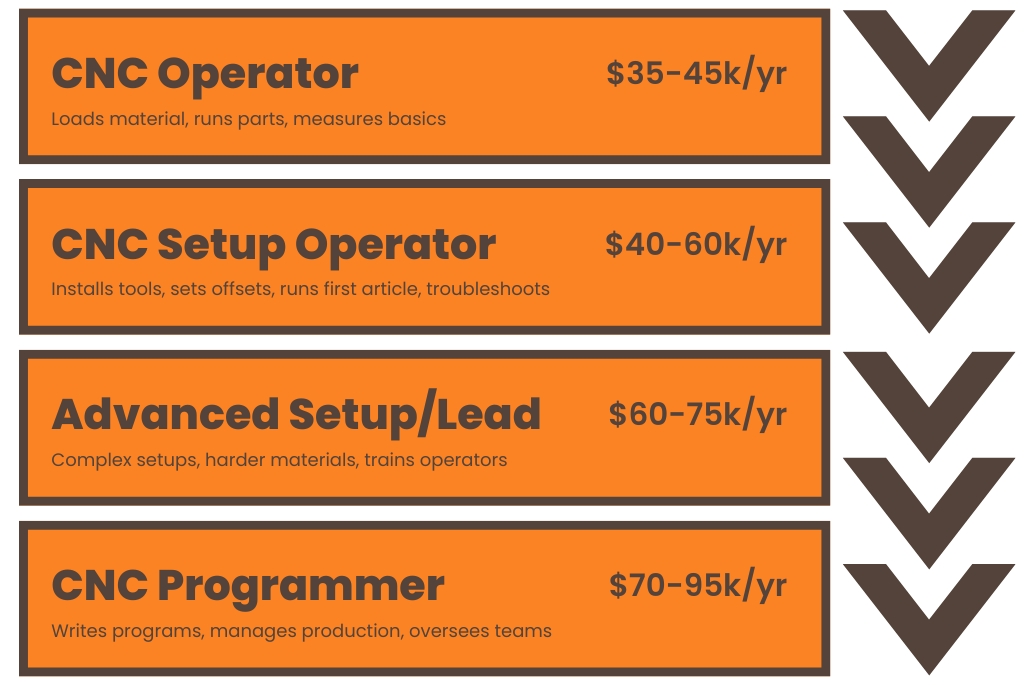
Year 1-2 (CNC Operator): $35,000-$45,000
- Loading and unloading parts
- Basic measurement
- Following setups created by others
Year 2-4 (CNC Setup Operator): $45,000-$60,000
- Independent setups
- Tooling selection
- Problem-solving when dimensions are wrong
- Pay increase from promotion: $5,000-$10,000
Year 4-8 (Advanced Setup/Lead): $60,000-$75,000
- Complex multi-axis setups
- Difficult materials (titanium, Inconel)
- Training other operators
- Pay increase from skill growth: $10,000-$15,000
Year 8+ (Programmer/Supervisor): $70,000-$95,000
- Writing CNC programs
- Managing production schedules
- Supervising other machinists
Learn specialized skills faster to increase pay faster. Multi-axis machine experience (4-axis or 5-axis) can add $10,000 to your salary because fewer people know how to do it.
Step-by-Step Career Path for CNC Setup Operators
Entry: High School & Training
If you’re still in high school:
- Take shop class, drafting, geometry, and algebra
- Some high schools have CNC machines and offer basic training
- Vocational high schools sometimes place students in apprenticeships during senior year
After high school: Enroll in a community college CNC program or technical school. Look for:
- At least 3 different CNC machines you’ll learn on
- Instructors who worked in manufacturing within the last 5 years
- Job placement rates above 80%
- Machines made within the last 10 years
Visit the school before enrolling. Ask to see the machine shop. If they won’t let you see it, don’t enroll there.
Entry Level: CNC Operator
Your first job will be operating machines someone else set up.
What you’ll do:
- Load raw material into the machine
- Press the cycle start button
- Wait 5-20 minutes for the part to finish cutting
- Remove the part
- Measure 3-5 dimensions with calipers
- Deburr sharp edges with a file or grinder
- Repeat 30-80 times per shift
What you’re learning:
- How different materials behave during cutting
- What good parts look and feel like
- Which dimensions matter most
- How setup operators solve problems
This phase lasts 6 months to 2 years depending on how quickly you learn and how many setup opportunities exist at your shop.
Advancing to CNC Setup Operator
You move up when you can consistently produce good parts as an operator and when a setup position opens.
What changes:
- You arrive at a machine with no tools installed
- You read the blueprint and work order
- You choose which tools to use based on the material and tolerances required
- You install tools, clamp the workpiece, enter measurements
- You run the first part and verify all dimensions are correct
- You troubleshoot if something is wrong
Why shops are cautious about promoting: A bad setup can scrap $500-$5,000 worth of material in 10 minutes. Damaged cutting tools cost $50-$500 each. Shops promote people who demonstrate:
- Attention to detail (catching small measurement errors)
- Problem-solving (figuring out why a dimension is wrong)
- Reliability (showing up on time, following procedures)
Next: CNC Programmer or Specialist Roles
After 3-5 years as a setup operator, you can move into:
CNC Programmer: You learn CAD/CAM software (Mastercam, Fusion 360, SolidWorks CAM) that writes the G-code automatically. Programming roles pay $65,000-$95,000 and involve less physical work.
Multi-axis specialist: You focus on complex 4-axis or 5-axis machines that can cut parts from multiple angles in one setup. These positions pay $70,000-$90,000 because the skill is rarer.
Shop supervisor: You manage other machinists, assign jobs, troubleshoot problems, and coordinate schedules. Pay: $70,000-$85,000.
Quality inspector: You measure finished parts using advanced equipment and verify they meet specifications. Pay: $55,000-$70,000.
Real-World Examples & Use Cases
Aerospace manufacturing: You might set up a machine to make a titanium bracket for a helicopter. The blueprint specifies tolerances of ±0.001 inches and requires complete documentation of which tools you used, which lot of material, and all your measurements. One part might take 6 hours of machine time across multiple setups. Aerospace work pays more but requires extensive paperwork and zero mistakes.
Medical device manufacturing: Setting up machines to make surgical screws 3mm in diameter. You work in a clean room wearing a hairnet and gloves. Surface finish must be extremely smooth (8 Ra or better) to prevent bacterial growth. Tolerances are often ±0.0002 inches. Pay is high but the work environment is controlled and sterile.
Automotive suppliers: You set up a machine to make 2,000 brake brackets. The setup takes 2 hours, then the machine runs automatically for 3 days. Your job is optimizing for speed and efficiency. Tolerances are looser (±0.005 inches typical). Pay is moderate but overtime is common.
Job shops: Monday you set up a lathe to make 50 hydraulic fittings. Tuesday you set up a mill to make 10 custom brackets. Wednesday you set up a different machine for 200 bushings. You see more variety but make less money than specialized manufacturers. This experience helps you learn faster because you’re exposed to more situations.
Pros & Cons of Choosing This Entry Path
Pros
You start earning quickly. Six months to two years of training, then you’re employed. Compare this to a four-year degree where you’re not earning for four years and might graduate with $40,000+ in debt.
Training costs less. Community college CNC programs cost $3,000-$15,000 total. Four-year degrees cost $40,000-$100,000+.
Clear advancement path. Operator → Setup → Programmer/Supervisor is straightforward. Each step has defined skills and responsibilities.
Skills transfer across industries. CNC skills work in aerospace, medical, automotive, defense, oil and gas, and general manufacturing. If one industry slows down, you can move to another.
Physical and mental balance. You’re not sitting at a desk all day, but you’re also using your brain to solve technical problems. Some people find this more satisfying than purely physical or purely mental work.
Cons
You’re standing 8-10 hours per day. Some shops have anti-fatigue mats. Some don’t. Your feet and back will hurt the first few weeks until you adjust.
Shop environment. Loud (earplugs required), sometimes hot in summer, sometimes cold in winter. Cutting fluids smell bad. Metal chips are sharp. You’ll go home dirty.
Irregular schedules. Manufacturing often runs two or three shifts. You might work 6am-2pm, 2pm-10pm, or 10pm-6am. Overtime is common during busy periods but your hours might get reduced hours during slow periods.
Physical risks exist. Rotating machinery can catch clothing. Hot chips can burn skin. Loud noise can damage hearing. Following safety procedures reduces risk dramatically, but it’s not an office environment.
Automation is changing requirements. Shops investing in the newest technology need fewer but more skilled setup operators. You can’t learn the basics and coast for 30 years. You need to keep learning new control systems and software.
Tools & Resources for Aspiring Operators
NIMS Certification
Website: https://www.nims-skills.org/credentialing
What it offers: Skills tests that prove competency
Cost: $100-$200 per test
Value: Recognized by all U.S. manufacturers
Haas Technical Education Centers
Website: https://www.haascnc.com/myhaas/haas_certification_US.html
What it offers: Free training on Haas CNC machines at partner schools
Cost: Free if enrolled in partner school
Value: Haas machines are extremely common, so this training applies directly to many jobs
Community College CNC Programs
What to look for:
- Programs with job placement rates above 80%
- Machines made within the last 10 years
- Instructors who worked in industry recently
- Partnerships with local manufacturers for internships
Cost: $3,000-$15,000 for complete program
Online resources
- Titans of CNC (YouTube channel with free tutorials)
- Haas Automation YouTube channel (machine operation tutorials)
- CNC Cookbook (technical articles and calculators)
- Practical Machinist forum (ask questions, get answers from experienced machinists)
Job search sites
- Job Boards (LinkedIn, Indeed, Glassdoor, etc.)
- Niche CNC Job Boards (like onlycncjobs.com)
- Local manufacturing staffing agencies
- Direct applications to manufacturers in your area
Conclusion
CNC Setup Operator is a practical entry into manufacturing that pays $40,000-$87,000 depending on experience and location. You need 6 months to 2 years of training, not a four-year degree.
The job involves preparing automated cutting machines to make parts: installing tools, programming measurements, running test pieces, and fixing problems. You start as a basic operator, advance to setup operator within 1-3 years, then move into programming or supervision if you want.
Demand is strong because production runs are getting smaller and more varied, which requires frequent machine reconfiguration. Automation handles repetitive tasks but hasn’t eliminated the need for skilled setup workers.
The work is physical (standing all day, some lifting), technical (reading blueprints, precision measurement), and involves problem-solving (figuring out why dimensions are wrong). If you’re comfortable with all three aspects and want a skill-based career, this path makes sense.
If you’re looking for a job as a CNC Setup Operator, check out the current job openings at Only CNC Jobs. Your future career may only be a few clicks away…