
A CNC machine can represent hundreds of thousands of dollars in capital equipment. The parts running on that machine may be aerospace components, medical devices, or tight-tolerance production pieces. Mistakes cost real money and missed shifts disrupt production schedules.
Because of that, CNC employers evaluate applications through a different lens than many office jobs. The resume is not just a list of skills. It is a signal about reliability, attention to detail, and work habits.
Small details on the page can quietly answer the question every shop owner asks before scheduling an interview:
Is this someone we can trust to run our machines and show up for their shift?
In this article, we’ll explain what CNC employers are looking for in your resume and the red flags that you should avoid if you want to land the job.
Table of Contents
How CNC Employers Read Resumes
Many job seekers assume hiring managers review resumes closely before making decisions. Research suggests the opposite.
A well-known eye-tracking study analyzing recruiter behavior found that employers spend about 7.4 seconds reviewing a resume during the initial screening stage.
Even if the exact number varies across organizations, the underlying reality remains consistent: the first pass through a resume is quick.
A report from the Bureau of Labor Statistics reinforces the same point. Resume reviewers often spend 30 seconds or less deciding whether a resume deserves deeper consideration.
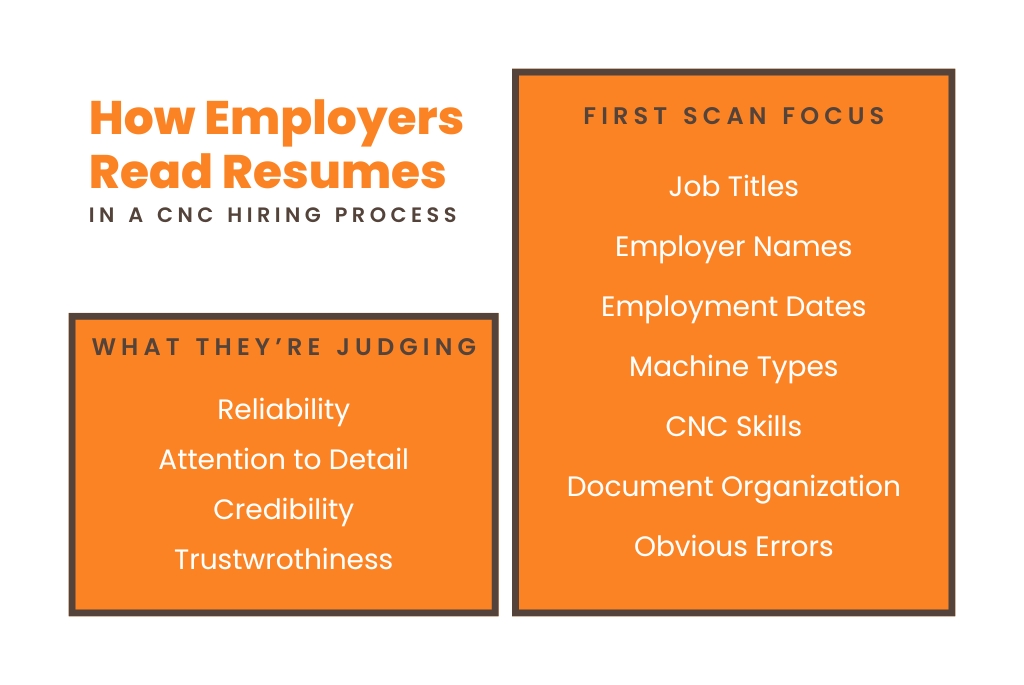
During that short window, hiring managers don’t read every sentence. They scan for specific information:
- Job titles
- Employer names
- Employment dates
- Equipment or skills listed
- Overall organization of the document
Anything confusing slows the reader down. When that happens, the resume often loses momentum.
For CNC employers, that scan serves a specific purpose. They’re not just identifying skills. They’re evaluating whether the applicant appears dependable enough to trust on a shop floor.
Why Manufacturing Hiring Managers Interpret Resumes Differently
Resume advice on the internet often assumes the hiring manager works in an office environment. Manufacturing hiring works differently because the operational risks are different.
According to the Bureau of Labor Statistics, machinists routinely:
- Read complex blueprints and CAD drawings
- Set up and operate CNC machine tools
- Monitor machine operations and make adjustments
- Measure finished parts to ensure they meet precise specifications
These tasks require accuracy and procedural discipline.
The occupational database O*NET reinforces that point. It lists Attention to Detail and Dependability among the core work styles required for machinists.
When employers read a resume for this type of role, they’re not just asking whether the candidate can operate a machine. They’re asking whether the candidate behaves like someone who can handle precision work consistently.
This mindset explains why seemingly minor resume mistakes carry more weight in CNC hiring than they might in other industries.
Resume Red Flags That Quietly Kill CNC Applications
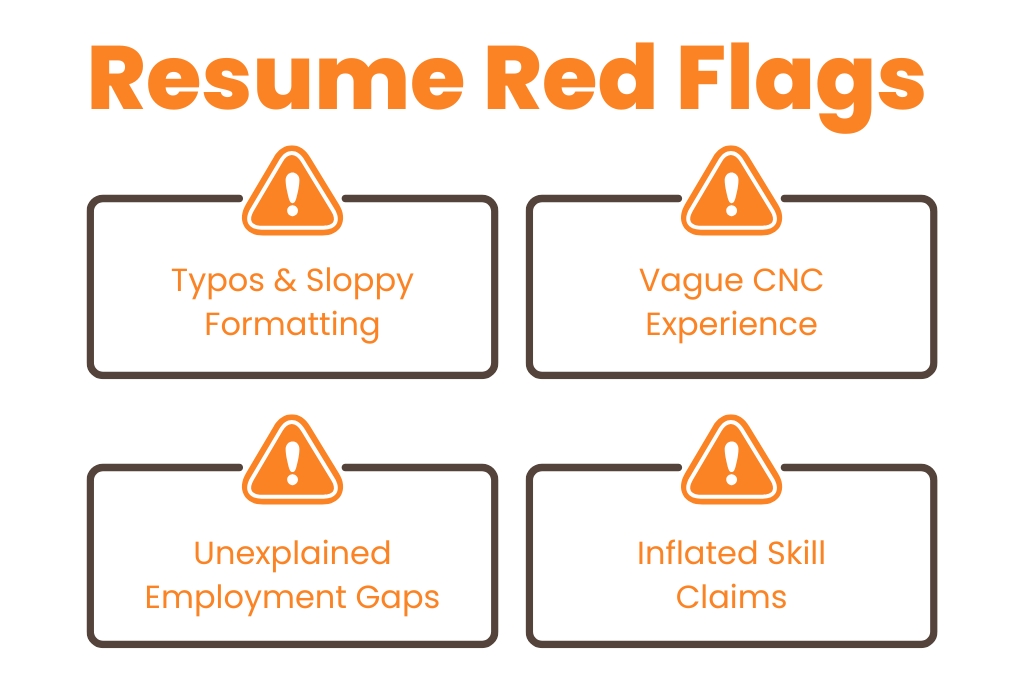
Typos And Sloppy Formatting
For many occupations, spelling errors are an annoyance. For machining jobs, they raise a more serious concern.
Research examining resume quality found that applicants with resumes containing spelling or grammar mistakes were less likely to be interviewed and were offered lower starting salaries when hired.
A resume represents a candidate’s best effort to present themselves professionally. If errors appear in that document, hiring managers may assume similar carelessness could show up in inspection reports, setup sheets, or part measurements.
That assumption may not always be correct but hiring decisions often depend on interpretation rather than certainty. In a role built around precision, attention to detail becomes an important factor when making a hire.
Vague CNC Experience
Another common weakness in CNC resumes is lack of specificity. Many resumes describe machining experience using language that could apply to almost any production job.
Statements like, “Operated CNC machines and produced parts,” tell the employer almost nothing useful.
The BLS description of machinist work emphasizes tasks like setting up CNC machine tools, aligning parts and fixtures, adjusting cutting speeds, and verifying finished products against design specifications. A resume should reflect that level of detail.
Consider the difference between these two lines:
“Operated CNC equipment to produce parts.”
“Set up and operated Haas VF-2 vertical mills producing aluminum components while maintaining ±0.001 tolerance and performing in-process inspection.”
The second version communicates several important skills:
- Familiarity with specific equipment
- Awareness of tolerance requirements
- Responsibility for inspection
Those details help hiring managers visualize the candidate inside a real shop environment.
Job Hopping & Employment Gaps
Manufacturing schedules rely heavily on stability.
When an operator fails to show up for a shift, the consequences ripple across the entire shop. Machines may sit idle. Production targets slip. Other employees absorb overtime.
Because of this, employment history receives scrutiny during CNC hiring.
Employment history stability strongly influences how employers interpret a candidate’s reliability. A large field experiment presented at the American Economic Association found clear evidence of “duration dependence,” meaning the likelihood of receiving a callback declines as unemployment duration increases, even when resumes are otherwise identical. The study also found that this effect becomes more pronounced in tight labor markets like the CNC industry.
In practice, hiring managers often treat employment continuity as an indicator of productivity and dependability. When a resume shows multiple short tenures or unexplained gaps, it introduces uncertainty about work habits and reliability.
Whether that interpretation is fair or not, it frequently influences hiring decisions before an interview ever takes place.
Inflated Skill Claims
Sometimes people exaggerate a bit on their technical resumes. While it may seem harmless to you, this is a risky approach in CNC hiring because the technical skills are easy to verify.
Interviewers may ask you to explain:
- How you set tool offsets
- How you troubleshoot chatter
- How you inspect parts to tolerance
- How you approach machine setup
If the resume lists advanced programming or setup experience that you can’t explain during the interview, your credibility collapses quickly.
Academic research on resume deception highlights how common exaggeration can be. One study examining resume behavior found that over 90% of participants engaged in some form of deception when constructing resumes in experimental conditions.
Even small exaggerations can erode trust. Once a hiring manager questions one part of the resume, they often reread the entire document more skeptically or disqualify you from the process completely.
The Most Important Trait for CNC Employers
There’s one thing that CNC employers are looking for in every employee: reliability.
It may seem obvious but employers want someone who will actually show up to the job when they say they will. Not everyone does.
Unscheduled absences are not a minor inconvenience in manufacturing. Data from the U.S. Bureau of Labor Statistics shows that absence rates in manufacturing typically hover around 2.9%, while production occupations often experience absence rates closer to 3–4%.
These absences directly affect productivity and production schedules. Workforce management research estimates that unscheduled absenteeism costs U.S. employers roughly $3,600 per hourly employee each year, driven by lost productivity, overtime costs, and operational disruptions.
When a CNC operator misses a shift unexpectedly, a machine may sit idle, jobs may fall behind schedule, and other operators may be pulled from their work to cover the gap. For employers running tight production timelines, attendance reliability becomes a critical hiring factor.
As a result, hiring managers often read resumes looking for indirect signals of reliability:
- Stable employment history
- Clear work timelines
- Experience in production environments
- Responsibilities involving quality control
These signals help employers guess whether a candidate will support the production schedule rather than disrupt it.
What A Strong CNC Resume Communicates
A strong CNC resume removes uncertainty quickly. Within a few seconds, the hiring manager should understand:
- What machines the candidate has worked with
- What type of production environment they operated in
- Whether they handled setup, operation, or inspection
- Whether their work history suggests stability
A simple, specific description of real shop experience often carries more weight than a polished but vague resume. In practice, the best CNC resumes do something subtle but powerful.
They reduce perceived hiring risk.
When the document communicates precision, stability, and credible experience, the employer is far more likely to continue reading.
Conclusion
The manufacturing sector urgently needs skilled workers but employers still exercise caution in hiring. CNC employers operate expensive equipment, tight schedules, and precision production environments. Because of that, they interpret resumes differently than many office-based recruiters.
Typos signal carelessness. Vague experience creates uncertainty. Unexplained job changes raise reliability questions. Inflated skills damage credibility.
These resume signals can quietly eliminate candidates before their technical skills are even evaluated.
A strong resume doesn’t try to impress the reader with buzzwords or complicated formatting. It simply demonstrates something every shop owner values: precision, credibility, and dependability.