Swiss machines can be a strong production advantage, but they can also create one of the narrowest staffing markets in CNC. Management sees a machine built for small, complex, high-precision parts and assumes the hiring challenge will look like a slightly harder version of standard turning. It usually doesn’t.
Once a shop adds Swiss capacity, it often starts competing for a much smaller pool of candidates with more specific setup, tooling, programming, and process-control skills than a generic “CNC machinist” title suggests. Because of this, shops need to adjust their recruitment strategies to target these specialized candidates.
Table of Contents
Why Swiss Hiring Is Different from General CNC Recruiting
Swiss work is not just standard turning on a different machine. It’s a distinct machining environment with its own setup logic, tooling behavior, process risks, and production advantages.
A shop can usually find candidates with lathe exposure but it’s much harder to find candidates who can confidently handle guide bushing logic, sliding-headstock behavior, tooling layout, offset control, bar-fed precision work, and process stability with limited supervision.
Swiss roles often demand a narrower mix of machine-specific technical judgment than general turning roles. Once the job moves beyond running stable work and into setup ownership, process correction, and tooling decisions, the candidate pool shrinks quickly.
What Swiss Machines Add Operationally
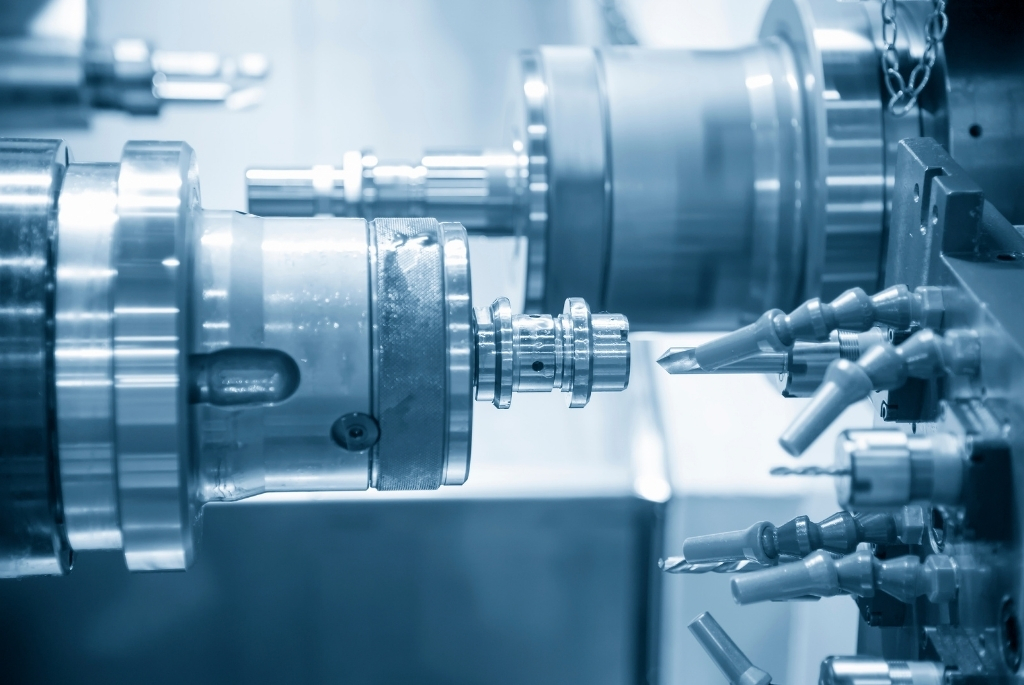
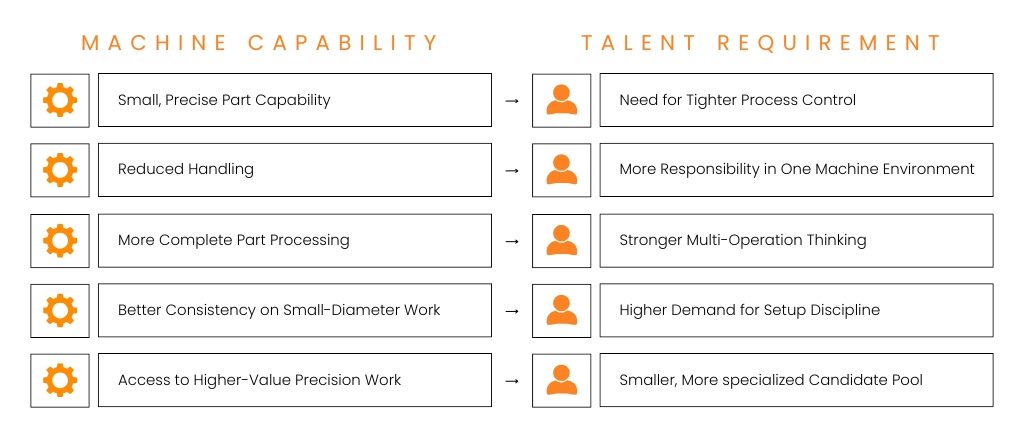
Swiss machining is built for small, precise, complex parts, and the machine design itself is part of the reason. That design advantage is exactly why Swiss can be so valuable operationally. It supports the kind of precision and part stability that many conventional turning environments struggle to match on small-diameter work.
But that same advantage also changes the labor requirement. A Swiss machine is not only more precise, but also often less forgiving. Weak setup decisions, poor tooling choices, sloppy offset control, or unstable process habits tend to matter more because the work is tighter, smaller, and more dependent on controlled, repeatable conditions.
The machine’s strength depends more heavily on the person’s ability to control a specialized process.
The Advantages of Adding Swiss Capacity
Swiss capacity can give a shop a real edge in the right industries.
Swiss machines can reduce handling, improve consistency, and support more complete part processing in one environment. In the right applications, that can mean fewer operations, fewer handoffs, and tighter control over part quality.
There’s also a commercial advantage. A shop with credible Swiss capability can compete for more demanding precision work that standard turning alone may not support efficiently.
While these advantages are great for the business, they usually make the role more specialized because more of the production burden sits inside one machine environment and one set of technical decisions.
The Skills Required for Swiss Work vs. Standard CNC Turning
A strong conventional lathe machinist usually needs to understand print reading, basic GD&T interpretation, turning fundamentals, feeds and speeds, offset management, tool wear, inspection, and stable setup execution. While that’s a substantial skillset, it still doesn’t automatically translate into Swiss machine readiness.
A capable Swiss machinist often needs that same foundation plus a more machine-specific and tightly integrated skill set.
Guide Bushing and Support Logic
Swiss machining depends on material support close to the cutting zone. That changes how the machinist thinks about bar stock behavior, part rigidity, and process stability on small or slender work.
Tooling Layout
Swiss machines often involve denser tooling arrangements and more process concentration. The machinist has to think through tool order, clearance, sequence, and interaction inside a tighter machine envelope.
Offset Control
Swiss roles require more than generic turning familiarity. They often require more focus on geometry, wear, and machine-specific offset work.
Process Stability
On many Swiss jobs, small variation can create outsized problems. A machinist needs to recognize when tooling, feed behavior, support conditions, or wear patterns are drifting before the process becomes unstable.
Programming and Setup Literacy
Swiss setup and programming are often treated as distinct learning areas layered on top of prior CNC knowledge rather than as entry-level machine operation.
Multi-Operation Thinking
Because Swiss environments can combine turning, milling, drilling, and threading, the role often requires a more complete understanding of how the full process interacts. The machinist is less likely to be working inside a narrow single-operation box and more likely to be responsible for how several operations behave together.
Prerequisites and Training Needed for Swiss Roles
Swiss competence is usually layered on top of earlier machining and turning knowledge. It is not treated like broad, interchangeable CNC labor.
Training programs reflect that clearly. Some require prior CNC operations experience. Others focus directly on Swiss equipment, tooling, setup, and programming. Others emphasize Swiss-style offsets, geometry, and wear adjustment.
That progression matters because it shows how the labor market is formed. Employers are often hiring for a role that assumes prior machining fundamentals plus Swiss-specific setup and programming competence.
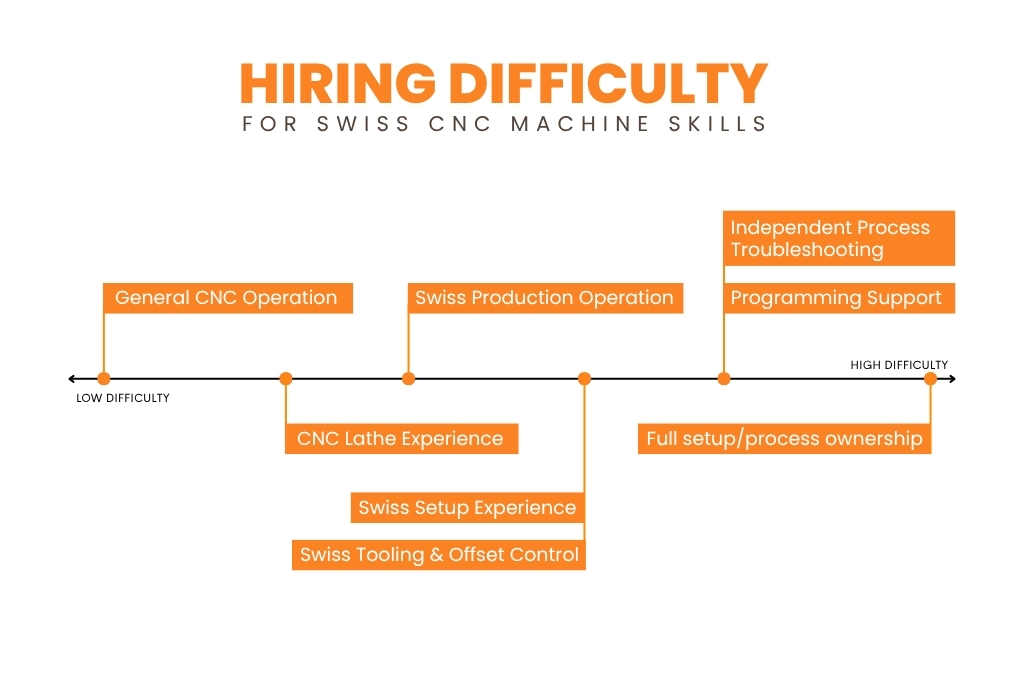
For employers, that means a requirement of “lathe experience” is not specific enough. A shop needs to know whether it is hiring for stable Swiss production, advanced setup ownership, process correction, programming support, or some mix of all four. The wider that skill mix becomes, the smaller the candidate market gets.
How Difficult Swiss Roles Are to Staff
Swiss roles sit in a high-difficulty staffing market, especially once the job requires independent setup, stronger programming awareness, or process stability with minimal support.
Not every Swiss machining role is equally hard to fill. A shop that can train an employee with strong turning fundamentals may have a broader talent market than a shop demanding immediate Swiss independence. Once the role includes setup ownership, offset control, tooling judgment, and correction of unstable process conditions, the search becomes much narrower.
Common Recruiting Mistakes in Swiss Environments
The first mistake is treating Swiss like standard turning.
That mistake shows up in job titles, compensation, and screening. The employer markets the role broadly, then interviews as if it were a highly specialized opening. That wastes time because the labor market for “general CNC” is not the same as the labor market for “Swiss setup and process ownership.”
The second mistake is stacking too many duties into one job. Setup, programming, troubleshooting, quality ownership, and process adjustment may all be valid needs, but they narrow the market when bundled into one role.
The third mistake is refusing to build a development path while also refusing to pay for direct Swiss expertise. Swiss machining ability is often developed through prior machining experience plus additional machine-specific learning. If a company won’t train and won’t pay for direct skill, it usually makes a difficult labor market nearly impossible.
What More Recruitable Swiss Machine Shops Do Differently
More recruitable Swiss shops decide early whether the role truly requires direct Swiss experience or whether strong turning talent can ramp into it. They separate must-have skills from trainable skills. They define whether the role is about stable production, advanced setup, programming support, or broader process ownership. And they back that up with real training, applications help, and process support rather than assuming the candidate will absorb the environment alone.
Why Swiss Expansion Often Forces a New Recruiting Strategy
Swiss capacity usually forces a shop to become more honest about labor.
The machine pushes management to clarify compensation, training, role scope, and the line between what must already exist in the hire and what can be developed over time.
Swiss machining is valuable not only because of what it makes possible on the floor, but because it exposes whether the company understands the labor requirements that come with more specialized equipment.
If you’re looking for specialized Swiss machining talent and need to advertise your role, get in touch with the team at Only CNC Jobs. Our specialized job board gives you the perfect place to market your open roles to candidates specifically in the market for CNC jobs.