There are plenty of factors effecting the success of your CNC recruiting efforts: job descriptions, hiring process, pay ranges, career growth opportunities, leadership and even commutes play a part in the success (or lack of) of your CNC recruiting efforts.
The machine mix you have in your shop is yet another variable affecting the success of your recruitment efforts. Different types of machines change the size of the candidate pool, the level of training required, and the amount of independence the role demands.
The differences are clear when looking at NIMS machining credentials: it separates credential tracks for CNC milling, CNC turning, CNC 5-axis milling, Swiss turning, and mill-turn work, and it distinguishes operator-level roles from specialist-level roles based on responsibility for proven versus unproven programs and more independent process control.
Below, we cover the most common CNC machines that shops are using, how the machine changes the candidates you’re searching for and what can be done to improve recruitment success.
Table of Contents
Why Machine Mix Is a Recruiting Variable, Not Just an Equipment Decision
A machine purchase changes more than production capability. It changes the shape of the job.
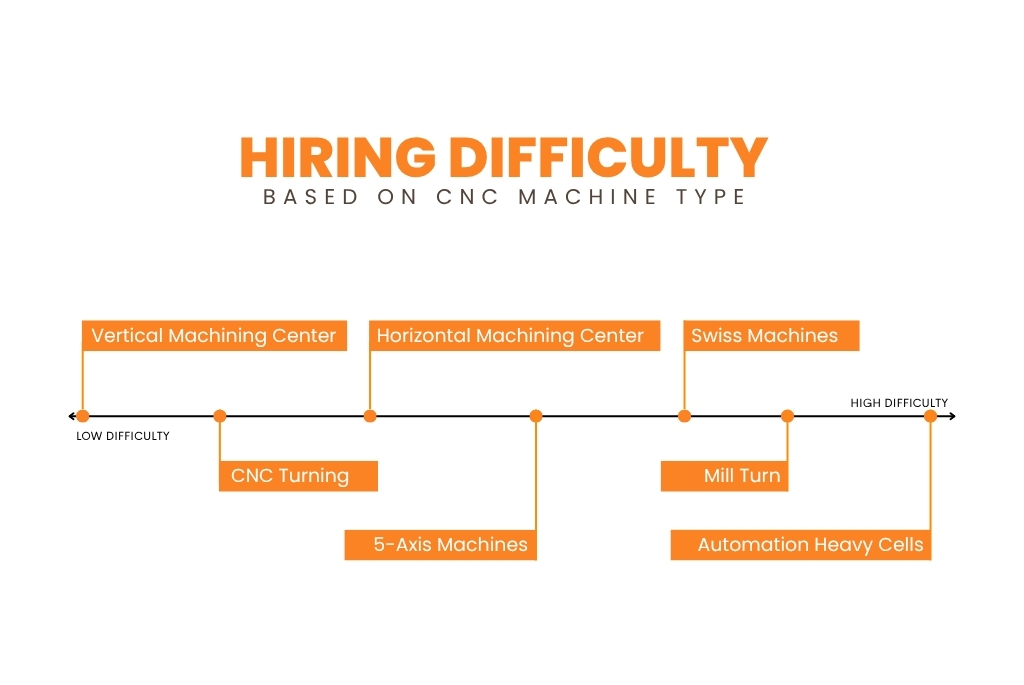
A VMC-heavy shop usually pulls from a broader labor market than a shop built around Swiss, 5-axis, or mill-turn work. That doesn’t mean VMC hiring is easy but it does mean more candidates are likely to have some relevant foundational exposure. As machine environments become more specialized or more layered, the search narrows because the role starts demanding more than general CNC familiarity.
That narrowing effect is visible in how the trade is credentialed. A CNC Milling Specialist is not framed the same way as a CNC 5-Axis Milling Specialist or a Swiss Turn Specialist. The distinctions between the roles matter because they show that advanced or specialized machine environments often create different labor categories, not just tougher versions of the same job.
This is where many shops misread their own hiring problems. They think they’re competing for the same generic talent pool as every other machine shop when their equipment decisions may have already pushed them into a narrower segment of the market.
The Three Recruiting Questions Every Machine Decision Should Trigger
1. How much does this machine narrow the candidate pool?
This is the first question that should be asked because it forces the business to define what kind of labor it needs.
A shop built around standard milling or turning may still have a difficult search, but it’s usually operating in a broader market than a shop requiring direct Swiss, 5-axis, or integrated mill-turn capability. The issue isn’t that one environment has labor and the other does not; the issue is that the share of candidates who can contribute quickly tends to shrink as the machine environment becomes more specialized or more demanding.
The 5-axis training pathway is a good example. Gene Haas Foundation course listings for multi-axis CNC milling are aimed at people who already have advanced 3-axis CNC mill, G-code programming, setup, and operation experience. That means the public training path itself treats multi-axis work as a progression built on prior skill, not as a normal entry point. Any role that requires progression like this will likely have a smaller talent pool.
2. What part of the role must be hired directly, and what part can be trained?
A posting may say “CNC machinist” but the floor reality may call for setup independence, troubleshooting confidence, process correction, inspection discipline, and maybe even programming support. Once all of that is bundled into one role, the talent market gets smaller very quickly.
The problem isn’t always labor scarcity by itself; sometimes it’s role inflation. A company quietly combines multiple responsibility levels into one job opening and then blames the market when the search stalls. If you expect people to work multiple roles within one, you should also expect your talent pool to be smaller.
NIMS distinguishes operator and specialist tracks in multiple machine categories. They make this split between operator vs specialist because proven-program execution and unproven-program ownership are not in the same labor tier. It may be easier to find operators, but if you need specialists on the team, you need to determine if you can train someone to fill that role or if you’ll need to run a more specialized search to hire that talent directly.
3. Does the shop have the systems to support the level of talent it says it wants?
A company may decide it can’t buy a finished 5-axis or Swiss specialist and instead needs to grow one internally. That can be a strong strategy, but it can also fail if the shop lacks documentation, consistent setup practices, reliable inspection habits, or time for mentorship.
The machine doesn’t determine whether internal development will work. The shop’s systems do.
That’s one reason machine mix matters so much in recruiting. More advanced equipment often increases the cost of vague processes. It becomes harder to train successfully when the environment depends on tribal knowledge or loose handoffs.
Vertical Machining Centers Usually Offer the Broadest Hiring Market
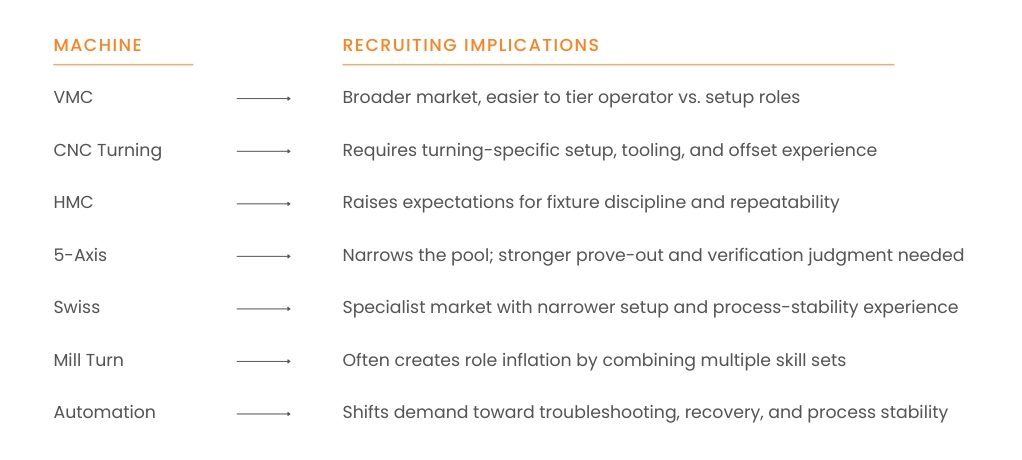
Vertical machining centers usually sit at the broadest end of the CNC hiring spectrum because they are closer to foundational milling experience.
Modern Machine Shop defines machining centers broadly as CNC milling and drilling machines with an automatic tool changer and notes that the category includes VMCs, HMCs, and 5-axis machining centers. It places VMCs inside the common foundation of machining center work rather than at the highly specialized edge.
That broader market gives VMC shops more room to build rational labor tiers. They can separate operator work from setup work. They can hire for current production support and train upward. They can also still make a mess of recruiting if they use vague job titles and hide specialist-level expectations inside a supposedly broad opening.
The lesson is not that VMC environments are easy to staff. It is that they are usually more recruitable when the employer scopes the role honestly.
CNC Lathes & Turning Centers Require a Different Talent Base
Turning centers do not usually create the narrowest labor market in CNC, but they do expose a different kind of hiring mistake.
Many employers act as if general CNC experience automatically transfers across mills and lathes. That assumption gets weaker at the setup level. Turning work often depends on its own tooling logic, offsets, work holding awareness, and process habits. That’s one reason public training paths separate turning from milling rather than treating one as a minor variation of the other.
Gene Haas Foundation listings distinguish turning-specific training and describe standard CNC turning as built around basic 2-axis lathe, G-code programming, setup, and operation experience.
The recruiting consequence is straightforward. Adding turning capacity may expand what the shop can make, but it also changes what kind of talent the shop needs.
Horizontal Machining Centers Raise Process Expectations
Horizontal Machining Centers (HMC) talent may not be rare, but HMC environments tend to reward stronger fixture discipline, setup consistency, and repeatability. That raises the value of process-minded talent.
An HMC role often becomes harder to fill when a shop advertises it like a generic mill position while expecting more mature setup behavior than the posting admits. To attract more process-minded talent that fit the roles needs, the job advertisement needs to be clearly thought out and defined before the search starts.
5-Axis Machines Expand Capability but Shrink the Talent Pool
5-axis is one of the clearest examples of machine mix narrowing the market.
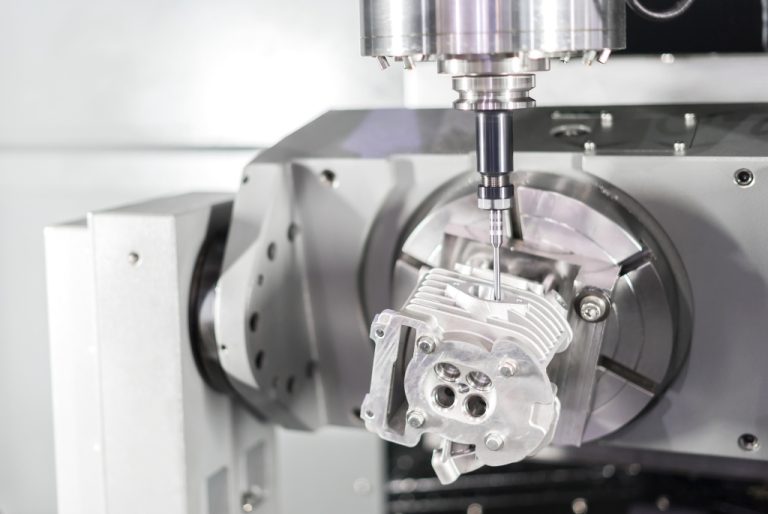
Modern Machine Shop defines a five-axis machine as one that adds two rotary axes in addition to X, Y, and Z so it can reach five sides of a part and machine smooth, complex, contoured surfaces.
That extra capability is exactly what makes hiring more difficult. 5-axis roles often demand stronger setup judgment, better verification habits, and more comfort with risk during prove-out.
In practical terms, 5-axis hiring gets hard when employers stop being honest about how much independence the role requires.
Swiss Machines Create One of the Narrowest Staffing Markets in CNC
Swiss machining pushes the specialization issue even further.
Swiss roles often require direct experience with a narrower mix of setup logic, tooling behavior, offsets, and process stability. The job title for these roles may still say “machinist” but the actual role is much closer to a specialist search.
That’s one reason Swiss environments often force management to get clearer about compensation, training, and role design. With the expectations of the role being higher than the typical machinist role, candidates want to know that they’re being taken care of and will work in an environment where they can thrive and grow.
Mill-Turn Machines Often Create Role Inflation
Mill-turn machines expose a different kind of recruitment problem.
The machine consolidates processes. Employers then assume the labor should also consolidate neatly into one hire. That’s where role inflation starts. The company ends up looking for one person who can think like a milling machinist, a turning machinist, a setup lead, and sometimes a programmer.
NIMS supports the idea that mill-turn is its own labor profile by listing CNC Mill-Turn Specialist separately rather than folding it into general CNC experience.
That doesn’t mean mill-turn roles are impossible to fill. It means the search gets much harder when the employer mistakes integrated machine capability for an abundant supply of integrated talent.
Searches for mill-turn roles can be more difficult because the supply of integrated talent for these roles is limited. Combining the skills of 3-5 roles into a single person significantly reduces the number of qualified candidates. Tighter requirements = less options.
Automation Changes the Kind of Talent a Shop Needs
Automation doesn’t eliminate staffing pressure; it moves it.
Automation usually increases the value of process stability, troubleshooting, recovery discipline, and systems thinking. A shop may need fewer people doing repetitive touch labor, but it often needs stronger ownership from the people who remain.
Automation should be treated as a shift in labor demand, not as a labor replacement. Good automation still relies on a quality process managed by people who can handle issues when they arise.
What the Most Recruitable Shops Do Differently
The shops that recruit the best tend to do three things better than everyone else:
- They define the job around the real machine environment rather than a generic title.
- They separate what must be bought from the market from what can be built internally.
- They match machine complexity with process discipline instead of assuming the right candidate will somehow compensate for weak systems.
A shop’s equipment strategy and recruiting strategy are tied together whether leadership acknowledges that connection or not. The machine mix your shop possesses will define the type of work you can do and the type of talent you require.
The businesses that hire better usually recognize this earlier and use a recruitment strategy that is customized to the type of talent that best fits their needs.