At 7:00 am, the first shift bell rings.
In one shop, operators drift toward machines still waiting on tooling, prints, or material. A supervisor scans yesterday’s schedule, already outdated. By mid-morning, a “hot job” hijacks the plan, and everything else slips.
Across town, another facility starts the same day very differently. Machines are kitted. Programs are loaded. Setups follow documented steps. By lunch, parts are already moving downstream exactly as planned.
Both are modern CNC facilities. Both invested heavily in equipment.
Only one is performing manufacturing operations that make results repeatable.
And in 2025, repeatability matters more than ever. With U.S. manufacturing projected to need 3.8 million new workers by 2033, and nearly 1.9 million roles at risk of going unfilled, shops can’t rely on heroics or tribal knowledge anymore.
Let’s break down the strategies that separate high-performing CNC shops from those stuck in daily firefighting.
Table of Contents
Measure What Actually Drives Performance
A common pattern shows up in struggling shops: dashboards everywhere, clarity nowhere.
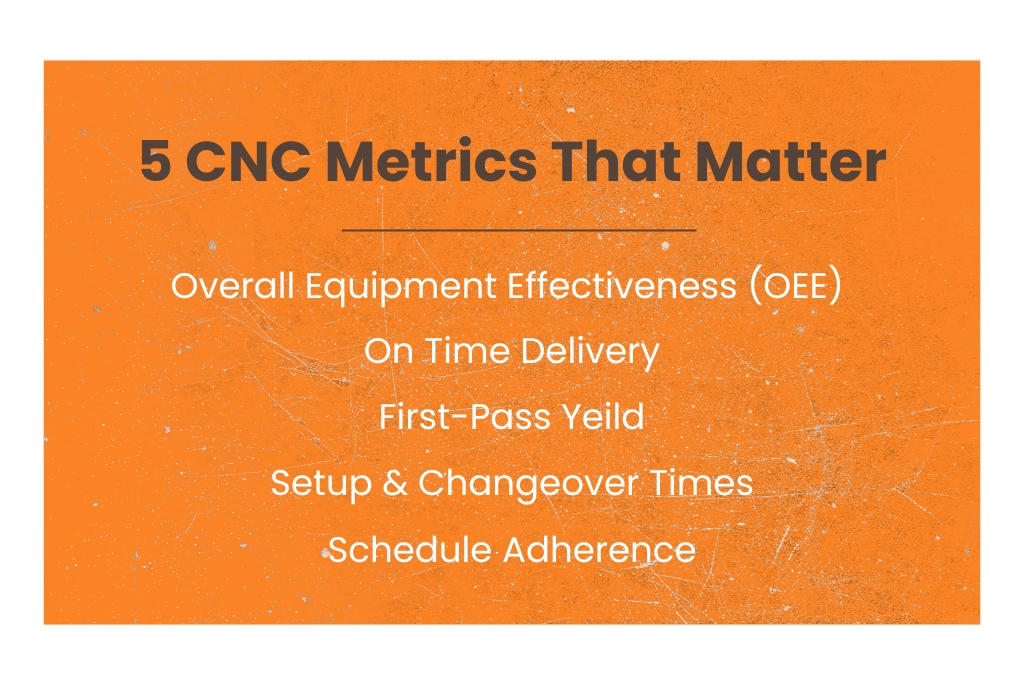
High-performing CNC facilities limit their focus to a small set of metrics that tell the truth about flow and delivery:
- Overall Equipment Effectiveness (OEE) on constraint machines
- On-time delivery to customer promise dates
- First-pass yield or scrap/rework rate
- Setup and changeover time
- Schedule adherence
Recent benchmarking across more than 1,400 discrete manufacturing operations shows average OEE at 66.8%, meaning most shops are leaving a third of capacity unused.
The difference between top performers isn’t perfection. It’s visibility and action where it matters most.
Treat Downtime Like a Financial Event
In many shops, downtime gets labeled as “just part of manufacturing.”
In high-performing shops, downtime is treated like a financial loss that demands investigation.
Industry data shows manufacturers lose an average of 30 hours of production per month to downtime, and 60% of leaders report annual disruption costs exceeding $250,000.
Top shops respond with structure:
- Standardized downtime codes
- Clear escalation rules
- Immediate containment first, root cause second
- Weekly downtime reviews with owners
- Deadlines
Instead of asking “Who broke the machine?”, leaders ask “Why did this happen, and why didn’t we catch it earlier?”
That shift alone changes culture.
Engineer Setups for Speed and Consistency
In an average shop, setup time depends on who’s working the machine.
In a high-performing shop, setup time depends on the process.
The best performing manufacturing operations treat setups as engineered systems:
- Identify high-volume or high-impact part families
- Standardize work holding and datums
- Pre-stage tools, fixtures, and programs
- Convert internal steps to external steps (practical SMED)
- Document the best-known method and train to it
Faster setups unlock smaller batch sizes, shorter lead times, and fewer schedule disruptions without adding machines or headcount.
Standard Work Keeps Quality Alive When People Change
When a senior setup lead retired, scrap spiked almost overnight. Nothing about the machines changed, only the absence of undocumented knowledge.
High-performing shops don’t let quality live inside individuals.
They rely on:
- Accurate setup sheets
- Current tool lists
- Clear first-article checklists
- Risk-based in-process inspection plans
- Visual controls for offsets and wear limits
Standard work isn’t bureaucracy. It’s insurance against turnover, growth, and unexpected absences.
Schedule for Flow, Not Wishful Utilization
Many schedules fail because they assume everything will go perfectly.
Top CNC shops assume the opposite.
They build schedules around constraints, not averages:
- The bottleneck machine sets the pace
- Supporting machines protect flow
- Near-term schedules are locked; future windows stay flexible
- Constraint jobs are fully kitted and verified
This approach matters even more as labor tightens. In late 2025, U.S. manufacturing reported roughly 410,000 open positions.
When people are scarce, stable schedules become a competitive advantage.
Kitting Turns Plans Into Reality
In underperforming shops, operators often spend the first hour of a shift “getting ready.”
In high-performing CNC facilities, that work already happened.
A complete kit includes:
- Correct revision print
- Verified material
- Approved program and setup documentation
- Staged tools and holders
- Available, calibrated gages
Some facilities even track kit completeness rate, knowing that incomplete kits almost always lead to late jobs.
It’s a simple practice with an outsized impact.
Build Quality Into the Process
In one shop, quality inspection was treated as a gate at the end of machining. Scrap showed up late, expensive, and hard to diagnose.
High-performing shops integrate quality into flow:
- First articles are reviewed quickly
- In-process checks catch drift early
- Measurement methods match feature risk
- Feedback loops between quality, programming, and operators are tight
The goal isn’t more inspection. It’s earlier feedback.
That’s how businesses scale without drowning in rework while performing manufacturing operations.
Maintenance That Prevents Surprises
Emergency maintenance feels heroic until it becomes routine.
Research cited in 2025 reliability studies estimates downtime can cost manufacturers up to $260,000 per hour, depending on operation size and industry.
High-performing CNC shops shift from reaction to predictability:
- Track top failure modes by machine group
- Perform simple, consistent condition checks
- Enforce PM compliance
- Stock critical spares for bottleneck machines
When machines behave predictably, schedules stop feeling like guesses.

Training That Creates Depth, Not Dependence
In weaker operations, training happens informally.
In strong operations, training is intentional.
High-performing CNC facilities use:
- Skill matrices by machine and task
- Short, focused training modules
- Clear sign-off criteria
- Cross-training tied to constraint support
This approach builds flexibility and helps retain talent in an industry facing long-term labor pressure.
Technology Should Support the System
Technology doesn’t fix broken processes. It amplifies existing ones.
Smart investments for CNC environments include:
- Tool-life management that’s actually used
- Probing and in-process verification
- Program revision control
- Digital work instructions
- Real-time machine visibility
With the global CNC machine tools market valued at approximately $29.5 billion in 2025, the need for smart investments in tools is apparent and competition between organizations continues to intensify.
Execution, not equipment alone, determines winners.
Where Only CNC Jobs Fits In: Smarter Staffing
Strong systems still need the right people.
High-performing CNC facilities rely on:
- Programmers who standardize, not just troubleshoot
- Setup leads who train others
- Operators who care about offsets, tool wear, and quality
Only CNC Jobs connects CNC-focused employers with professionals who thrive in structured, performance-driven environments.
When the right people meet the right systems, performing manufacturing operations becomes sustainable, not stressful.
The High-Performance CNC Checklist
- Track OEE on constraint machines
- Act on downtime data
- Engineer setups for speed
- Standardize work
- Schedule around flow
- Kit jobs completely
- Build quality into the process
- Make maintenance predictable
- Train with intention
- Invest in technology that supports execution
Shops that follow these principles don’t just keep machines running.
They build CNC operations that customers trust and competitors struggle to match.