
Hiring CNC machinists feels harder than it used to. Shops struggle to keep machines staffed. Workers see steady job openings even when headlines say manufacturing employment is flat.
That tension raises a simple but important question.
How many new CNC machinists does the U.S. manufacturing sector need each year to keep up with retirements and ongoing demand?
Based on the most recent U.S. Bureau of Labor Statistics employment projections for 2024 to 2034, the answer depends on how narrowly CNC work is defined.
Using a broad definition that reflects how most shops operate, the U.S. manufacturing sector needs approximately 46,100 new CNC machining workers per year to keep up with retirements, career changes, and limited growth.
Using a strict definition that includes only job titles with CNC in the name, the number is about 16,600 new workers per year.
Both figures matter. Together, they explain why CNC hiring remains difficult in a slow growth environment.
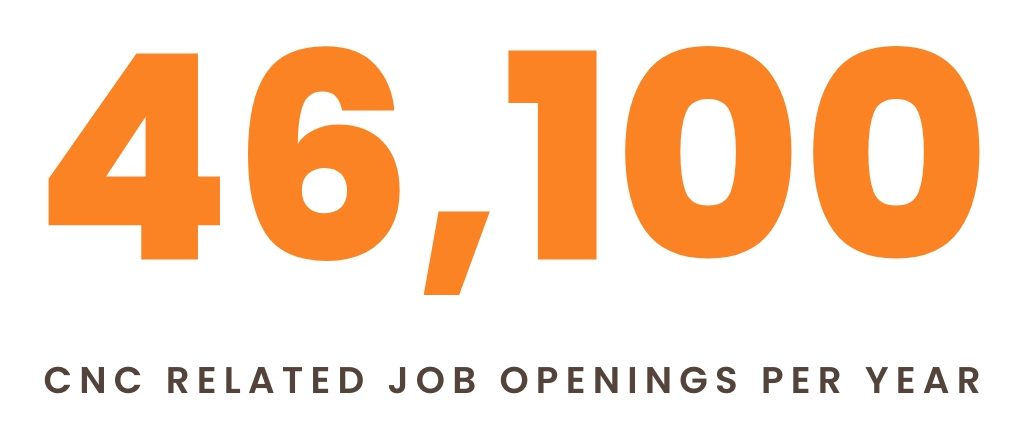
Table of Contents
What “New CNC Machinists Needed Each Year” Measures
When manufacturers ask how many CNC machinists are needed, they are usually asking how many new workers must enter the field each year to keep production running.
That figure includes three components tracked by the Bureau of Labor Statistics (BLS).
- Workers retiring or leaving the labor force
- Workers leaving CNC roles for other occupations
- Net job growth or decline
BLS combines these factors into a single metric called “annual average occupational openings”. This number is designed to represent how many new workers are needed each year to maintain staffing levels.
For CNC hiring, this metric is far more useful than growth rates alone.
The Most Accurate Data Driven Answer
CNC Only Definition
For a strict CNC definition, BLS separates two occupations.
- Computer Numerically Controlled Tool Operators
- Computer Numerically Controlled Tool Programmers
Based on 2024 to 2034 projections:
- CNC Tool Operators account for approximately 13,500 openings per year
- CNC Tool Programmers account for approximately 3,100 openings per year
That produces a total of about 16,600 CNC specific openings per year.
This definition works well for workforce planning tied to job titles or training programs that focus only on CNC labeled roles.
Broad CNC Machining Workforce Definition
In practice, many workers who operate or set up CNC equipment are classified as machinists rather than CNC operators.
BLS places machinists in a separate occupation even though CNC work is central to most machinist roles.
When machinists are included, the picture changes significantly.
Annual average openings by occupation:
- Machinists: 29,500 openings per year
- CNC Tool Operators: 13,500 openings per year
- CNC Tool Programmers: 3,100 openings per year
That produces a total of approximately 46,100 CNC machining workforce openings per year.
For most hiring managers, this broader figure better reflects real world CNC staffing needs.
Why Openings Stay High Even When Employment Is Flat
One of the most misunderstood aspects of CNC hiring is the relationship between employment growth and job openings.
Machinist employment is projected to remain almost unchanged over the next decade. Despite that, tens of thousands of machinist hires are still required every year.
The reason is separations.
Machinists
For machinists, nearly all annual openings come from workers leaving the occupation.
Each year, roughly:
- 17,000 machinists transfer into other occupations
That creates about 29,500 openings per year that must be filled just to maintain staffing levels.
Growth plays almost no role in machinist hiring demand.
CNC Tool Operators
CNC tool operator employment is projected to decline by roughly 10% by 2034.
Even so, the occupation still generates about 13,500 openings per year.
Separations remain high enough that shops continue hiring, even as the total number of roles slowly decreases.
This explains why CNC operator job postings remain common despite a negative long-term outlook.
CNC Tool Programmers
CNC tool programmers make up a smaller workforce, but their hiring pressure is intense.
With only about 28,000 workers nationwide, the need for roughly 3,100 new programmers per year represents a significant share of the occupation.
This helps explain persistent competition for experienced programmers across regions.
Annual Replacement Rates Are Higher Than Most Shops Expect
One way to understand hiring pressure is to compare annual openings to total employment.
When that calculation is applied to CNC-related roles, the results are eye-opening.
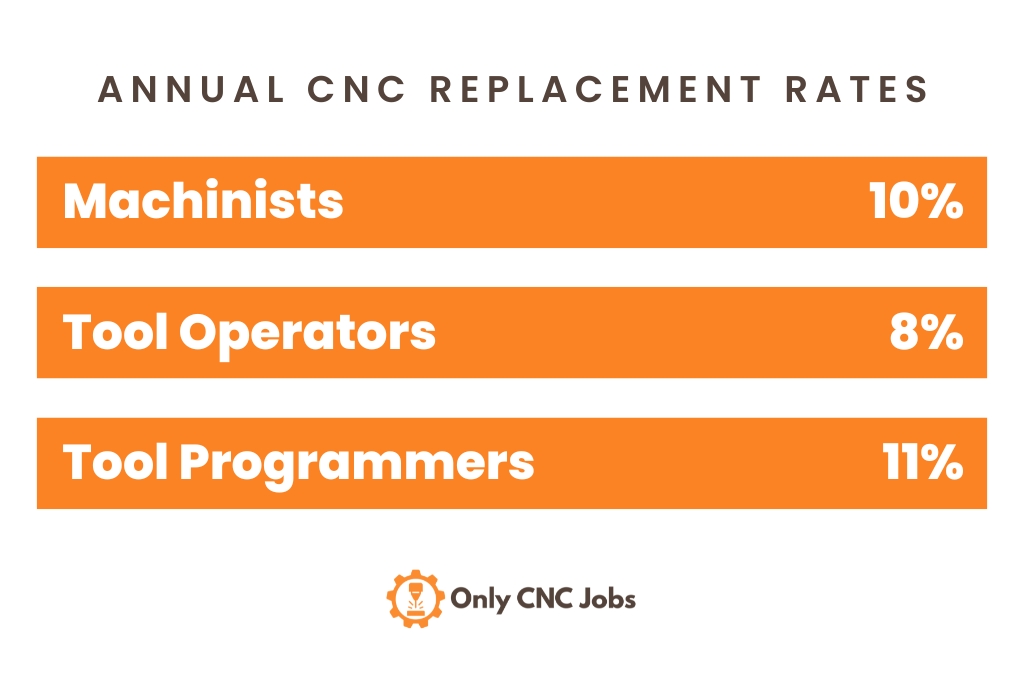
Approximate annual replacement rates:
- Machinists: about 10% of the workforce per year
- CNC Tool Operators: about 8% per year
- CNC Tool Programmers: about 11% per year
This means a shop employing 40 machinists should reasonably expect to replace four workers each year under normal conditions.
Hiring challenges often feel worse than expected because many hires are replacing departures rather than expanding capacity.
What This Means for CNC Workers
For CNC workers and those considering the trade, the data points to several clear conclusions.
Openings Will Continue Even Without Strong Growth
CNC employment growth may be limited, but replacement demand ensures steady opportunities for trained workers.
This is especially true for machinists and programmers, where retirements and transfers drive most hiring.
Skill Progression Still Matters
BLS wage data shows meaningful differences across CNC related roles.
- CNC Tool Operators earn just under $50,000
- Machinists earn a median wage above $56,000
- CNC Tool Programmers earn more than $65,000
Workers who develop setup, troubleshooting, and programming skills position themselves for both higher pay and stronger job security.
What This Means for CNC Hiring Managers
For employers, the data supports a shift in how CNC staffing is planned.
Plan For Replacements, Not Just Growth
Annual replacement demand should be treated as a baseline hiring requirement.
Ignoring this reality leads to chronic understaffing and reactive recruiting.
Retention Matters as Much as Recruiting
Occupational transfers account for a large share of CNC separations. Workers often leave CNC roles for quality, maintenance, programming, or supervisory positions.
Clear advancement paths help reduce these exits.
Build Internal CNC Talent Pipelines
The data supports structured progression from operator to machinist to programmer.
Shops that grow talent internally reduce exposure to the most competitive segments of the labor market.
Methodology
This analysis uses U.S. Bureau of Labor Statistics Employment Projections for 2024 to 2034.
The primary metric analyzed is annual average occupational openings, which accounts for employment change and worker separations, including labor force exits and occupational transfers.
Two workforce definitions were used:
- A CNC only definition including CNC tool operators and CNC tool programmers
- A broad CNC machining workforce definition including machinists, CNC tool operators, and CNC tool programmers
Employment levels, separations, and wage figures were drawn directly from BLS projections and BLS wage sources.
Bottom Line
The U.S. manufacturing sector needs a steady flow of new CNC capable workers every year.
Depending on how CNC roles are defined:
- About 16,600 new CNC workers per year are needed under a strict definition
- About 46,100 new CNC machining workers per year are needed under a realistic shop floor definition
CNC hiring pressure is driven primarily by retirements and career movement, not rapid employment growth. If experienced workers continue to leave the trade, demand for new CNC talent will remain strong.
If you’re looking for new CNC talent, get in touch with Only CNC Jobs to start promoting your open role on an industry specialized job board!